SEO Strategy: How to Build a Roadmap for Sustainable Growth
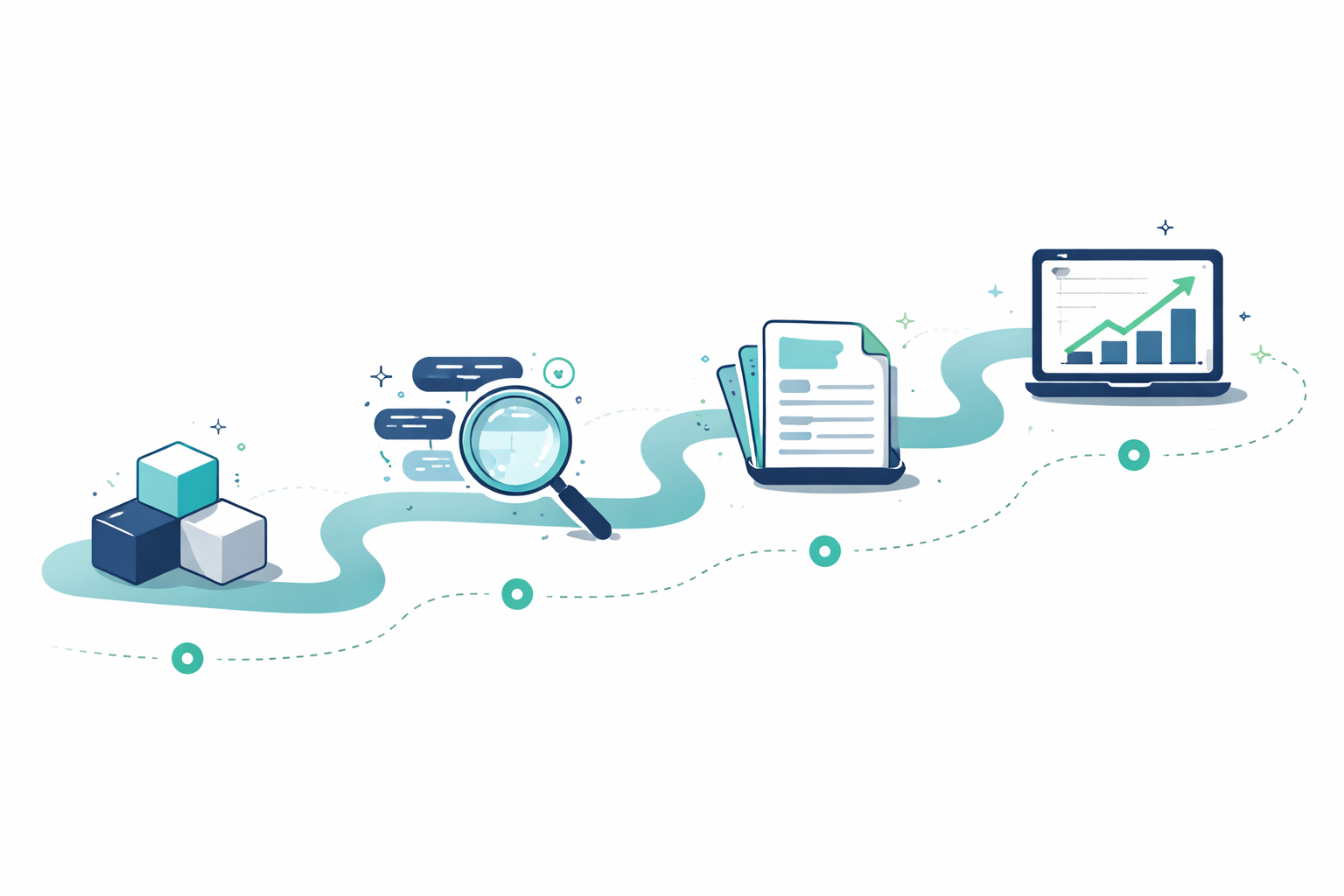
An effective SEO strategy roadmap breaks down into four core phases that build on each other over time:
- Foundation: Resolve technical SEO blockers, crawlability, indexing, site architecture, before investing in content or link building.
- Keyword and content strategy: Identify search terms aligned to buyer intent and map them to a content calendar that supports business goals.
- Content production and optimization: Publish consistently, targeting both traditional search rankings and AI-powered search visibility.
- Measurement and iteration: Track meaningful engagement metrics, not vanity numbers, and adjust strategy based on what the data actually shows.
- Timeline expectation: Most businesses see measurable SEO ROI within 7–9 months, with returns compounding significantly after the first year.
- Critical caveat: No amount of content or link building will overcome unresolved technical issues. Fix the foundation first.
Bottom line: A sustainable SEO roadmap prioritizes technical health, aligns content to real search demand, and treats SEO as a compounding investment, not a quick fix.
Introduction
Most businesses don’t fail at SEO because they chose the wrong keywords or published the wrong content. They fail because they never had a roadmap in the first place.
Without a structured plan, SEO becomes a collection of disconnected tactics, a blog post here, a meta tag update there, maybe some link building when someone remembers to ask for it. The result is wasted budget, stalled rankings, and the kind of frustration that makes leadership question whether SEO is worth the investment at all.
It is worth the investment. Organic search still accounts for over 53% of all trackable website traffic, and well-executed SEO campaigns deliver a median ROI of roughly 748% across industries. But those returns don’t come from scattered effort. They come from a SEO strategy built around your business goals, a phased roadmap that builds momentum over time instead of chasing shortcuts.
Here’s how to build one.
Phase 1: Fix the Foundation (Technical SEO)
Before you write a single blog post or build a single backlink, you need to know whether Google can actually find, crawl, and index your website properly. Technical SEO issues are the silent killers of organic growth. A site with brilliant content means nothing if search engines can’t access it.
The most common technical blockers include misconfigured noindex tags that prevent pages from appearing in search results, broken internal links that create crawl errors across the site, missing or incomplete schema markup, slow page load speeds, and poor mobile responsiveness.
These aren’t minor optimizations. They’re prerequisites. Investing in content production while technical issues remain unresolved is like running paid ads to a landing page that’s offline. Everything downstream depends on getting this phase right.
A technical SEO audit should evaluate crawlability and indexation status for every important page, site architecture and internal linking structure, Core Web Vitals performance, mobile usability, and structured data implementation. Resolve what the audit surfaces before moving to Phase 2. This is where most businesses try to skip ahead and where most SEO strategies start to break down.
Phase 2: Keyword Strategy and Content Mapping
With a clean technical foundation, the next phase is understanding what your potential customers are actually searching for and how to connect your business to that demand.
Effective keyword research in 2026 goes beyond search volume and competition scores. The goal is to map keywords to buyer intent, understanding not just what people are typing, but where they are in the decision-making process and what kind of answer they expect.
This means categorizing keywords into intent tiers. Informational queries (people researching a problem) should drive educational blog content. Commercial investigation queries (people comparing solutions) should map to comparison pages, like understanding the differences between SEO, AEO, and GEO service descriptions, and case studies. Transactional queries (people ready to act) should point to your core service and landing pages.
From there, build a content map that connects these keyword clusters to specific pages on your site. Each piece of content should have a clear purpose within the larger strategy, supporting a pillar page, targeting a geographic service area through programmatic SEO to scale content across service areas, or building topical authority in a specific vertical.
The most common mistake at this stage is producing content in a vacuum. A blog post without a strategic role in your keyword map is just noise. Every page should earn its place.
Phase 3: Content Production and Optimization
This is where most people want to start, and the reason so many SEO efforts stall. Content production without the strategic groundwork from Phases 1 and 2 leads to a library of pages that don’t rank, don’t convert, and don’t connect to anything meaningful.
With a roadmap in place, content production becomes systematic. You know what to write, why it matters for your business, and where it fits within the larger strategy. The execution itself should follow several principles.
First, prioritize depth over volume. One comprehensive, well-researched article that thoroughly addresses a topic will outperform five thin posts that barely scratch the surface. Search engines reward content that satisfies user intent completely, not content that exists just to fill a publishing calendar.
Second, optimize for how people actually search now. That means writing for traditional search rankings and for the AI-driven search platforms that are reshaping how answers get delivered. AI Overviews and conversational search tools increasingly pull from content that demonstrates expertise, provides structured answers, and cites credible sources. Optimizing for AI-driven search platforms is no longer optional — it’s a parallel track that needs to be part of every content strategy.
Third, build internal linking deliberately. Every new piece of content is an opportunity to strengthen the pages that matter most to your business. Link from blog posts to service pages. Link between related articles. Create a web of content that tells search engines and users, how your expertise connects.
A realistic production target for most businesses is 10–20 articles per month, scaled to match available resources and business priorities. Consistency matters more than bursts of activity.
Phase 4: Measurement and Iteration
SEO is not a project with a finish line. It’s an ongoing process of measurement, learning, and refinement. The businesses that sustain organic growth are the ones that treat their roadmap as a living document, not a one-time plan.
The key is measuring the right things. Raw traffic numbers can be misleading, especially in the early stages of an SEO campaign or when technical issues are suppressing visibility. More meaningful indicators include engagement quality metrics such as time on page, pages per session, and bounce rate trends; keyword ranking movement across your target terms; organic conversion rates and lead quality; and indexed page count relative to your total published content.
When technical foundations are solid and content is consistently published, these metrics tend to follow a predictable pattern. Early months show improvements in indexation and ranking movement. Months 4–6 typically bring noticeable traffic growth. By months 7–9, most businesses see measurable ROI and the returns compound from there.
The iteration part is equally important. Use your data to identify what’s working and double down. Find content gaps where competitors are ranking and you aren’t. Update older content that’s losing rankings. Adjust your keyword strategy based on actual performance rather than initial assumptions.
Why Most SEO Strategies Fail
It’s worth addressing directly: the majority of businesses that invest in SEO don’t get the results they expected. That’s not because SEO doesn’t work. It’s because most SEO strategies have one or more of these structural problems.
They skip the technical foundation. Content and link building get all the attention while crawl errors, indexing issues, and site architecture problems quietly undermine everything. Until the foundation is solid, nothing built on top of it will perform at its potential.
They treat SEO as a one-time project. A site audit, a few blog posts, and some on-page optimizations, then nothing. SEO rewards sustained effort over time. The compounding nature of organic growth means that stopping after three months leaves most of the value on the table.
They measure the wrong things. Focusing on vanity metrics like raw session counts instead of engagement quality and conversion rates leads to misguided strategy decisions. A page that gets 500 visits and generates 20 qualified leads is worth more than a page that gets 5,000 visits and generates nothing.
They don’t connect SEO to business outcomes. Rankings and traffic are intermediate metrics. The roadmap should ultimately connect to revenue, through lead generation, consultation requests, or direct conversions. If your SEO strategy can’t draw a line from keyword rankings to business results, it needs to be restructured.
Building a Roadmap That Actually Works
The difference between businesses that succeed with SEO and those that don’t usually isn’t budget, industry, or competition. It’s whether they approached SEO with a structured plan or a collection of ad hoc tactics.
Companies like a national training provider that drove measurable organic growth and a wellness practice that built sustained visibility didn’t achieve results by accident. They followed a phased approach, resolving technical issues first, building content strategy around real search demand, producing consistently, and measuring what mattered.
Organic search remains the single largest driver of website traffic and one of the highest-ROI channels available to any business. But it only delivers those returns when it’s treated as a strategic investment with a clear roadmap, not a line item that gets attention when someone remembers to ask about it.
The roadmap doesn’t need to be complicated. It needs to be structured, prioritized correctly, and executed consistently. Start with the foundation. Build with intention. Measure what matters. And keep going.
Ready to build your SEO roadmap? Start with a discovery conversation and find out where the biggest opportunities are hiding in your current search presence.
FAQ Section
How long does it take to see results from an SEO strategy? Most businesses begin seeing measurable ROI within 7–9 months of consistent execution. Early indicators like improved indexation and ranking movement often appear within the first 2–3 months, but meaningful traffic and conversion growth typically require 6+ months of sustained effort.
What should come first in an SEO roadmap — content or technical fixes? Technical fixes should always come first. Issues like crawl errors, noindex misconfigurations, and broken internal links will suppress the performance of any content you produce. Think of technical SEO as the infrastructure that everything else depends on.
How much content do I need to publish for SEO to work? There’s no universal number, but consistency matters more than volume. For most businesses, 10–20 articles per month provides enough momentum to build topical authority and ranking traction. A single well-researched, comprehensive article will always outperform multiple thin posts.
Is SEO still worth investing in with AI search changing everything? Organic search still drives over 53% of all website traffic and delivers a median ROI of roughly 748% across industries. AI-powered search is reshaping how results get delivered, but it’s pulling from the same high-quality content that ranks in traditional search. Investing in both traditional SEO and AI search optimization is the strongest position.
What’s the biggest mistake businesses make with SEO? Skipping the technical foundation. It’s not the most exciting part of SEO, but unresolved technical issues will quietly undermine every other investment you make — from content to link building to on-page optimization. Fix the foundation first, then build.