Local Programmatic SEO for Service Businesses: Scale Rankings Across Your Region
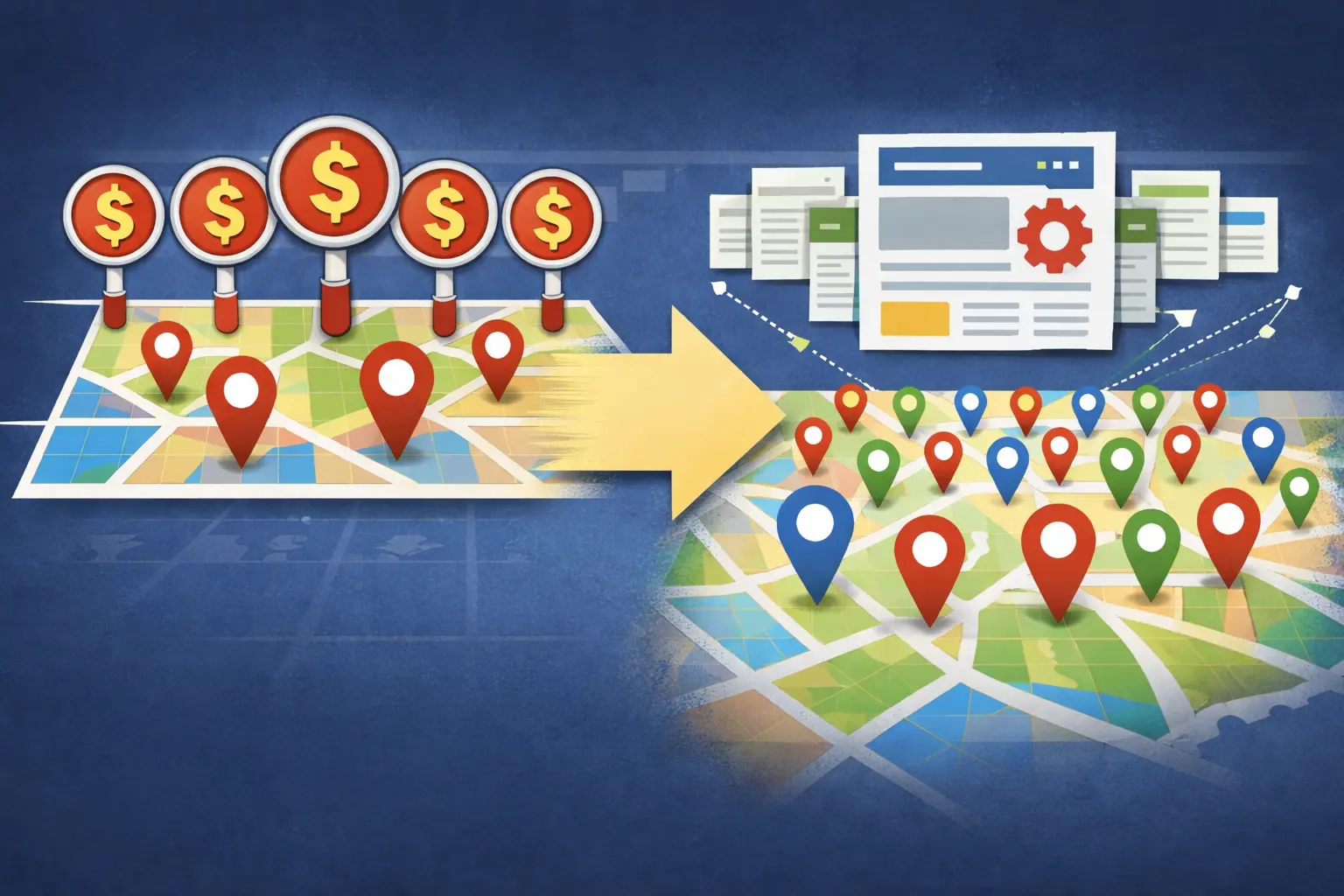
The Problem:
You want local visibility across your entire target region. But traditional local SEO requires hiring a local SEO specialist for each city. That’s expensive, inconsistent, and unsustainable.
The Solution:
Local programmatic SEO means one location page template plus location database plus automation equals rank across all the neighborhoods and service areas you serve without creating pages manually for each one.
Why It Matters:
- Local search volume across your service area is massive
- Most competitors optimize for 1-2 neighborhoods, missing the rest
- You can capture search volume across all neighborhoods you serve
- Lead generation grows across your entire service area, not just from your main location
The Results:
- Dozens of location pages ranking for local keywords
- 3-5x more lead volume than single-location focus
- Consistent brand messaging across all markets
- Sustainable competitive advantage that compounds over time
The Local SEO Scaling Problem (That Most Businesses Face)
You operate a service business in a major city or metro area. Maybe you run a plumbing company with 3 dispatch centers across Jacksonville. Or a dental practice with 2 locations in Miami. Or an HVAC company serving the Atlanta metro.
You serve many neighborhoods. Your service area is much larger than your physical locations. When someone in San Marco searches “emergency plumbing near me,” they’re ready to call. Right now.
But here’s what happens with traditional local SEO: You try to optimize for the neighborhoods you serve, but you have one main location page. You rank well in the neighborhoods near your dispatch centers. But you’re invisible in the neighborhoods on the other side of town – even though you serve them.
The traditional approach: manually create a page for every neighborhood. That’s 25+ pages, 25+ sets of updates, 25+ tracking processes. The manual work breaks immediately.
That’s the scaling trap. And it’s exactly why local programmatic SEO exists.
What Is Local Programmatic SEO?
Programmatic SEO means using automation to generate large volumes of optimized pages from a single template and a data source.
Local programmatic SEO applies this principle to location pages: one template plus location database equals hundreds of automatically generated, fully optimized location pages across your target geography.
The 4-Layer System
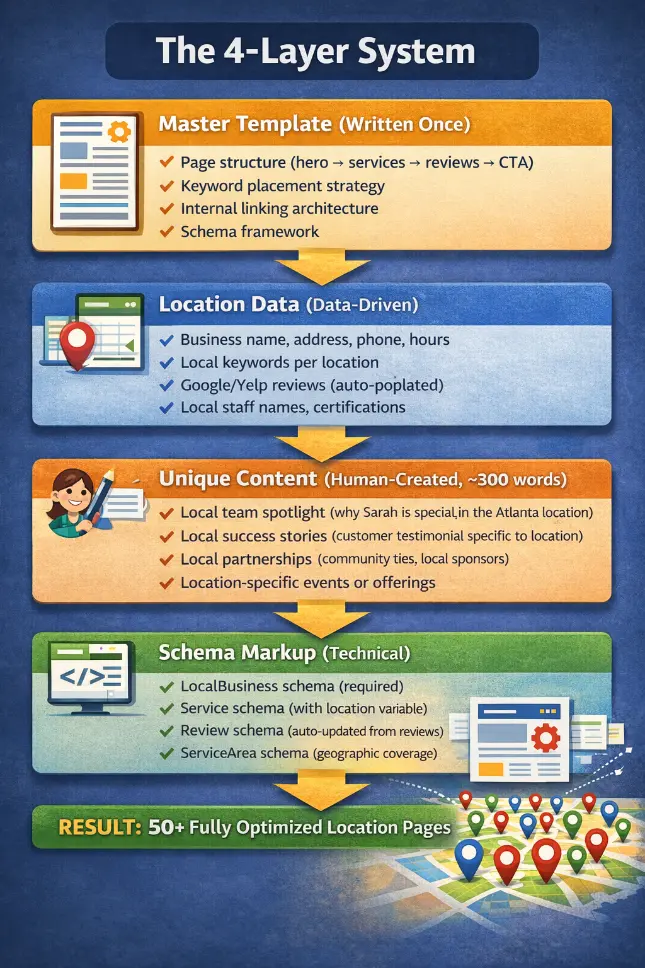
Local programmatic SEO works through a simple but powerful 4-layer framework:
Layer 1: Master Template (Written Once)
You build one location page template that serves as the foundation for all pages. This template includes the core structure and strategy elements:
- Page structure (hero section, services, reviews, call-to-action)
- Keyword placement strategy (where local keywords appear)
- Internal linking architecture (how pages connect to each other)
- Schema framework (technical markup structure)
Write this once. Deploy it hundreds of times.
Layer 2: Location Data (Data-Driven)
You create a simple database or spreadsheet with every location you want to rank for:
- Business name, address, phone number, hours
- Local keywords for each location (“pilates in [city]”, “[service] near [city]”)
- Google and Yelp reviews (auto-populated automatically)
- Local staff names, certifications, or credentials
This data drives the customization. Each location gets different data, creating unique pages.
Layer 3: Unique Content (Human-Created, ~300 words)
This is critical for avoiding thin content penalties. For each location, you create 300 words of unique content:
- Local team spotlight (why your instructor matters in this specific location)
- Local success stories (customer testimonials specific to that city)
- Local partnerships (community connections, local business relationships)
- Location-specific events or offerings (what makes this location special)
The 75/25 rule: 75% of each page comes from the template. 25% is unique local content. This ensures Google sees each page as distinct while maintaining efficiency.
Layer 4: Schema Markup (Technical)
The automation layer connects everything together:
- LocalBusiness schema (tells Google this is a real business location)
- Service schema (with location variable – specifies what service is available where)
- Review schema (auto-updated from reviews – freshness signal)
- ServiceArea schema (geographic coverage – which neighborhoods this location serves)
Result: 50+ Fully Optimized Location Pages
When you combine these four layers, automation creates a fully optimized location page for every entry in your location database. No manual work per page. No redundant effort. One page at a time, your location coverage expands across your target geography.
How it works:
You build one master location page template that includes:
- Strategic keyword placement optimized for local search
- Internal linking structure that distributes authority
- Schema markup that tells Google your business locations
- Conversion elements (phone, booking CTA, directions)
- Unique content sections
Then you create a simple database with every city/location you want to rank for:
- City name and coordinates
- Local keywords (“fitness classes in [city]”)
- Basic location data
- Unique local information (staff, testimonials, local partnerships)
Automation connects your template to your database. When you add a city to the database, it automatically creates a fully optimized location page for that city. No manual work. No redundant effort. One page at a time, your location coverage expands.
The result: Instead of hiring 10 local SEOs for 10 cities, you manage one system that generates pages for dozens of cities.
Why This Works for Service Businesses
Traditional SEO operates on a manual basis: write one article, optimize for one keyword, publish.
Programmatic SEO operates on a template basis: write one template, populate with location data, generate hundreds of pages automatically.
For service businesses specifically, this creates three powerful advantages:
1. Local Keywords Have Clear Intent
When someone searches “pilates classes in Buckhead” or “physical therapy in Midtown Atlanta,” they have high purchase intent. They’re not researching – they’re ready to buy or book.
Local programmatic SEO targets these exact searches across dozens of cities. Each location page ranks for “[Service] in [City]” + variations. Users in each city find your location page in search results.
Compared to national keywords (where competition is brutal), these local keywords are achievable and convert better.
2. Each Page Is Unique (No Thin Content)
The risk with programmatic pages is thin content – pages that look identical with just a city name changed.
You avoid this by making 25% of each page unique: local team spotlights, local testimonials, local partnerships, city-specific insights. The 75% template structure ensures consistency. The 25% unique content ensures Google doesn’t flag pages as duplicates.
Result: Pages rank individually while benefiting from shared domain authority.
3. Domain Authority Compounds
Your first location page strengthens your domain slightly. Your 10th page strengthens it more. By page 50+, your domain is powerful for local searches.
This means location page 50 ranks faster than location page 1. The system gets stronger as it grows. This is a competitive moat most competitors can’t match because they’re managing locations individually.
Real Example: Service Business Dominating a Metro Area
A plumbing company with 3 dispatch centers across Jacksonville wanted to rank for emergency plumbing calls across their entire service area. They couldn’t afford to hire a local SEO person for every neighborhood. Instead, they built a local programmatic SEO system.
The Setup:
Master template: Location page optimized for plumbing keywords and emergency service calls
Database: 25 neighborhoods and municipalities across Jacksonville (Beach, San Marco, Riverside, Arlington, Southside, etc.)
Unique content: Local service area information, neighborhood-specific testimonials, local plumbing partnerships
Implementation:
Week 1: Template design and keyword research for Jacksonville service areas
Week 2: Write unique content sections (neighborhood info, testimonials, local partnerships)
Week 3: Deploy all 25 location/neighborhood pages
Results (4 Months Post-Launch):
Local keyword rankings: 85+ rankings across 25 service areas
Organic traffic from local pages: 280+ monthly sessions
Qualified emergency plumbing calls: 8-12/month attributed to programmatic pages
Cost per call: ~$20-30 per call (vs. $45-60 from paid search)
Revenue attributed: $40K-60K annually (assuming $500-750 average service call value)
Key Impact:
The business could now respond to emergency plumbing searches in every neighborhood they served without hiring separate SEO specialists for each area. Rather than ranking in only the neighborhoods near their 3 dispatch centers, they ranked across the entire city.
They didn’t need to hire local SEO managers. They deployed one system across their entire service area.
How Local Programmatic SEO Compares to Traditional Local SEO
| Aspect | Traditional Local SEO | Local Programmatic SEO |
| Approach | Optimize each location manually | Build template system, generate pages automatically |
| Scalability | Breaks at 10-15 locations | Efficient at 50+ locations |
| Consistency | Different strategies per location | Unified framework, location-specific data |
| Time per location | 30-40 hours to optimize | 2-4 hours to deploy (after template built) |
| Cost structure | Multiplies with each location | Fixed upfront, then scales efficiently |
| Brand messaging | Fragments across locations | Consistent framework everywhere |
| ROI timeline | 3-6 months per location | 3-6 months across all locations |
When Local Programmatic SEO Makes Sense (Decision Framework)
Local PSEO is ideal when:
You have (or plan to have) 10+ locations Below 10, traditional local SEO is fine. Above 10, the economics shift dramatically in favor of programmatic.
Your service is location-relevant Fitness, healthcare, professional services, consulting – yes. Pure online services – no.
You can provide location-specific data Local testimonials, staff bios, local partnerships. This prevents thin content and makes each page valuable.
You want sustainable competitive advantage Most competitors can’t scale this way. If you build it, you gain a moat that compounds.
Don’t do this if:
- You have only 1-3 locations (traditional local SEO is sufficient)
- You can’t gather location-specific data (staff, testimonials, local insights)
- Your service is purely national/online (no geographic relevance)
- You expect instant results (give it 4-6 months)
The Strategic Advantage: Regional Dominance
Here’s what’s powerful about local programmatic SEO at scale:
Instead of ranking in 2-3 neighborhoods near your locations, you become “the dominant option across your entire service area.”
Users searching for your service in every neighborhood you serve find you in those search results. This establishes you as the area authority in your niche – not just the business with locations in downtown and midtown, but a trusted option everywhere customers need you.
This network effect compounds:
- More pages = more internal linking opportunities
- More local signals = stronger topical authority
- Stronger domain = faster rankings for new locations
- Faster rankings = quicker lead generation in new markets
For expansion-focused businesses, this is transformative. Launch a new location and you already have organic visibility. Expand into a new market and search traffic comes with you.
Long-Tail Local Keywords: The Real Opportunity
National keywords like “fitness classes” are brutally competitive. You can’t rank. Spending on ads is expensive.
But local keywords are different:
- “Fitness classes in Buckhead” = 90 searches/month, low competition
- “Pilates for back pain in Midtown” = 60 searches/month, medium competition
- “Reformer classes near Druid Hills” = 40 searches/month, low competition
Individually, these keywords are small. But across 50 cities, they aggregate to meaningful traffic.
A single location page can target 5-10 keyword variations, each with real search volume. Multiply that by 50 locations and you’re covering hundreds of local keyword opportunities.
Most competitors don’t capture this because they focus on 1-2 core neighborhoods. You capture all of it across your entire service area.
Making Each Page Unique (Avoiding Thin Content)
The biggest risk with programmatic pages is Google penalizing them as duplicate/thin content. You prevent this through strategic uniqueness:
Template Content (75% – consistent across all locations):
- Service descriptions
- Benefits of your service
- How to book/contact
- Service area information
- Schema markup
Unique Content (25% – specific to each location):
- Local team member bios
- Local customer testimonials
- Local partnerships (doctors, gyms, corporate sponsors)
- Local events or community involvement
- City-specific demographics or needs
Example: A pilates studio’s Buckhead page highlights their Buckhead instructor and mentions their partnership with a local orthopedist. Their Midtown page features a different instructor and partnership with a CrossFit gym. Same template structure. Different unique content. Different page value.
This prevents thin content penalties while maintaining the efficiency of the template approach.
Why Domain Authority Matters (And How It Scales)
In traditional SEO, each location page is somewhat isolated. Location A might rank. Location B might not. Results are unpredictable.
In programmatic SEO, each location page strengthens your entire domain:
Your first location page contributes to domain authority. Your 10th page contributes more. By page 50+, your domain is powerful for local search in your niche.
This creates a compounding advantage:
- Page 1 = base domain authority
- Page 20 = stronger domain = better page prospects
- Page 50 = strong domain = new pages rank faster
- Page 100 = very strong domain = new pages rank in weeks instead of months
This is why programmatic SEO gets more efficient as you scale. Early pages require patience. Later pages benefit from domain strength built by earlier pages.
Getting Started: Questions to Ask Yourself
Before implementing local programmatic SEO, ask:
1. Does our service area include multiple neighborhoods or municipalities? If you serve only one neighborhood, traditional SEO is fine. If you serve 10+ neighborhoods but manually optimize for only 1-2 of them, programmatic SEO helps you rank across all of them.
2. Can we gather location-specific data? Do you have (or can you get) local testimonials, staff information, local partnerships? Without this, pages risk being thin.
3. What’s the opportunity cost? How much revenue are you losing by not ranking in markets where you could serve customers? Calculate this. The number often shocks people.
4. Do we have a realistic timeline? This isn’t a 30-day tactic. Expect 4-6 months for stable, predictable results. But the compounding advantage lasts years.
5. Are we committed to ongoing optimization? Launch and forget doesn’t work. Monthly review management, quarterly keyword updates, ongoing monitoring. It’s systematic, not set-and-forget.
Key Takeaway
Local programmatic SEO isn’t about managing multiple physical locations better. It’s about generating optimized pages for every neighborhood and service area you cover automatically.
The result: lead generation from all the neighborhoods you serve, not just the ones near your dispatch centers or main office. Sustainable competitive advantage that gets stronger as your domain authority builds from multiple ranking pages. Complete service area dominance instead of partial neighborhood visibility.
For service businesses that serve a larger area than they can manually optimize for, this is the unfair advantage most competitors haven’t discovered.
Your Next Step
If local programmatic SEO resonates – if you’re thinking about expansion, frustrated with traditional local SEO costs, or want sustainable visibility across your target region – schedule a consultation.
We’ll analyze your geographic opportunity, show you what’s realistic for your business, and recommend whether (and how) programmatic SEO fits your growth strategy.
Frequently Asked Questions About Programmatic Local SEO
What’s a realistic example of programmatic SEO for a service business?
A plumbing company with 3 dispatch centers across Jacksonville uses programmatic SEO to rank for emergency plumbing calls in every neighborhood they serve – not just the areas near their dispatch centers. Instead of one main location page, they create pages for Beach, San Marco, Riverside, Arlington, Avondale, Southside, etc. Same service, different neighborhoods. Same template, different neighborhood data. Result: they rank for “[service] in [neighborhood]” searches across their entire city, not just 1-2 core areas.
How does programmatic SEO work for a single-location or multi-location service business?
Whether you have 1 or 5 physical locations, programmatic SEO helps you rank for every service area you cover. The geographic reach of a service business usually exceeds the number of physical locations. A landscaping company might have 2 warehouses but serve 30 neighborhoods. Programmatic SEO creates pages for all 30 neighborhoods, not just the 2 warehouse locations. Your coverage becomes your competitive advantage.
Should I use this if my business only serves one city?
Yes, especially if you serve a large city or metro area with multiple neighborhoods, municipalities, or districts. The core principle is the same: create dedicated pages for every geographic segment you want to rank in. A dental practice in Miami can create pages for Coral Gables, Wynwood, South Beach, Allapattah, etc. One practice. Multiple service areas. Programmatic pages for each.
Won’t Google penalize similar pages?
Only if pages are thin or duplicate. Each page must provide unique value – neighborhood-specific information, testimonials from that area, local partnerships, area-specific insights. A plumbing page for Riverside isn’t identical to a page for San Marco. They target different customers, different neighborhoods, different issues. Properly executed, unique pages strengthen domain authority.
How long until we see results?
Initial rankings in months 2-3. Stable results by month 4-6. Lead generation from local programmatic pages compounds as your domain authority strengthens from multiple ranking pages.
Can we do this for multiple service types?
Yes. A full-service business (plumbing + HVAC + electrical) can build separate systems for each service, each with its own template and location/service area database. Or create one flexible template that adapts across services.
What data do we need to get started?
Minimum: list of all neighborhoods/service areas you want to rank in, local keywords for each area, basic service area info. Ideal: testimonials from customers in each area, area-specific service details, local partnerships within those neighborhoods.
Does every location/neighborhood page need to rank?
No. Some rank well. Others rank for related keywords. Some don’t rank at all. But the system is designed to maximize coverage across all the areas you serve. More pages = more chances to appear in local search results.
How do we track which service areas are driving calls?
Use location-specific tracking in Google Analytics (UTM parameters by neighborhood), call tracking with area-specific phone numbers, ranking monitoring by service area, aggregated reporting showing which neighborhoods drive the most business.
Can we update pages after launch?
Yes. Update your database and pages update automatically. Want to add a new neighborhood? Add a row to your spreadsheet. The page is built and deployed. This is why the system is powerful – managing neighborhoods individually is impractical. Updating a database is simple.
Is this a one-time project or ongoing work?
Both. Initial setup: 2-4 weeks. Ongoing: monthly performance review, quarterly keyword updates, continuous monitoring and optimization. It’s a living system, not a one-off project.